
Some common Questions and Answers.

Implementing a successful food waste collection service requires coordinated planning across policy, operations, technology, and community engagement. At Integrated Skills, we support local authorities and waste operators through every stage of this journey — using our proven modelling expertise, digital tools, and practical experience to deliver efficient, compliant and cost-effective services.
A clear policy foundation is the starting point. Authorities must align with the Environment Act 2021 and upcoming DEFRA consistency requirements for weekly food waste collections. Once objectives and service scope are set, the next step is robust feasibility work. This is where Integrated Skills’ strengths come to the fore. Using advanced GIS, participation modelling and our SmartSuite route optimisation platform, we help organisations understand tonnages, fleet requirements, cost implications and carbon impacts. The outcome is a realistic set of service options grounded in reliable operational data.
Treatment capacity, whether anaerobic digestion or composting, must be secured early, but the real efficiencies come when the collection system is designed using optimised rounds, appropriate vehicles and well-planned deployment. Integrated Skills provides digital in-cab and operational management integrations that ensure crews have the right data at the right time, enabling accurate reporting of participation, contamination and service issues.
Once equipment and software are in place, successful food waste services rely on strong communications. Our solutions integrate seamlessly with CRM systems, enabling clear resident messaging, service updates and behaviour-change campaigns. Many authorities choose to run a pilot first; SmartSuite’s analytics support rapid evaluation, allowing teams to refine routes, adjust resources and improve participation.
After rollout, ongoing optimisation is essential. Integrated Skills provides the data insight required to monitor KPIs, track performance trends, reduce contamination and continually improve service efficiency.
From initial modelling to long-term optimisation, Integrated Skills delivers the digital tools and operational intelligence that make food waste collections work.
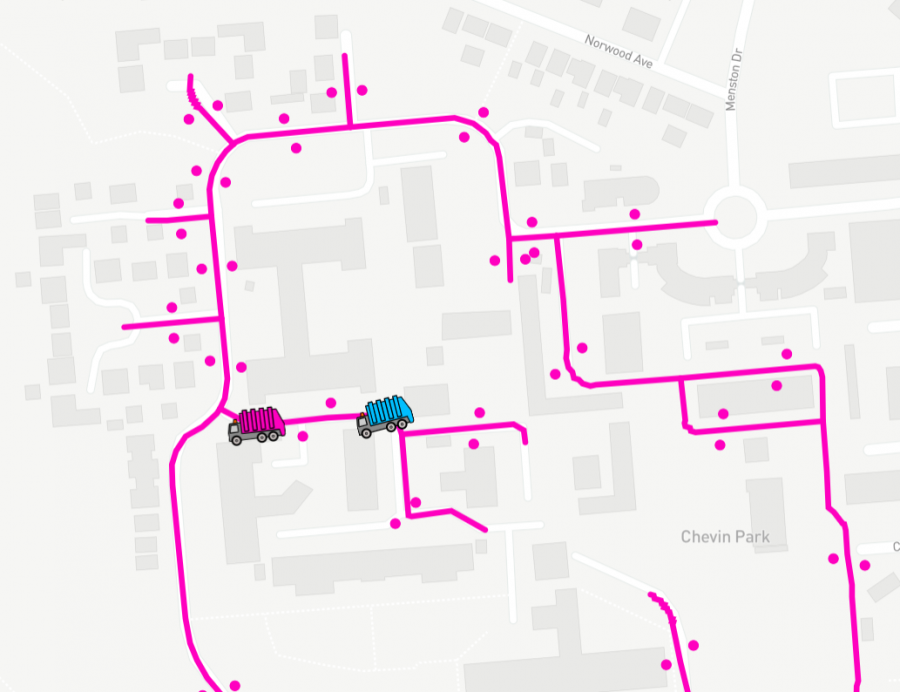
Strategic route planning is the long-term, high-level process of designing optimal service networks — determining the most efficient routes, territories, depot locations and fleet structures to meet future operational demands. It goes far beyond daily routing, looking months or years ahead to ensure organisations are operating in the right way, from the right places, with the right resources.
At Integrated Skills, we specialise in supporting local authorities, utilities, postal operators and logistics providers with precisely this challenge. Using our advanced GIS-driven route planning and optimisation solutions, we help organisations redesign their service networks for maximum efficiency, reduced costs, improved service quality and lower carbon impact.
Strategic route planning focuses on critical objectives: defining service territories, balancing workloads, right-sizing fleets, testing depot or facility locations, and assessing future demand. Our modelling tools enable detailed scenario planning — allowing organisations to explore “what-if” situations such as population growth, policy change, new waste streams, or rising fuel costs. These insights inform robust, long-term decisions on infrastructure investment, service redesign and resource allocation.
By combining GIS analysis, accurate road-network data, demographic information and historical operational datasets, Integrated Skills produces realistic and operationally deliverable route models. This allows teams to confidently evaluate options such as new depots, redesigned collection rounds, changes to service frequency, or the introduction of new services like food waste collections.
Whether the objective is to reconfigure waste collection rounds, rebalance postal or field-service territories, or plan future emergency-response coverage, Integrated Skills provides the modelling intelligence, optimisation tools and domain expertise needed to build resilient, future-ready service networks.
If you’d like, I can also produce a clear diagram that shows how strategic, tactical and operational route planning fit together.
For waste management operations, effective route optimisation is critical to improving efficiency, reducing costs, and maintaining compliance. The right solution must handle the complexities unique to the sector — from residential, commercial, roll-off, and hazardous waste to organic and recycling streams — while respecting vehicle capacities, time windows, property-specific service requirements, and regulatory constraints.
RouteSmart, distributed and supported by Integrated Skills in the UK is specifically designed for these challenges. It delivers precise, property-level routing, supports multiple waste streams per vehicle, and balances workloads across crews. Built on advanced GIS and modelling, RouteSmart allows operators to plan “what-if” scenarios, re-optimise rounds periodically, and accommodate both scheduled and ad-hoc collections. By integrating road-network data, bin types, and collection constraints, it ensures operational efficiency while reducing mileage, fuel use, and emissions.
A strong waste-sector route optimiser must also offer real-time monitoring, driver navigation, and reporting capabilities. RouteSmart achieves this by providing clear insights into route performance, service compliance, and operational bottlenecks. The platform is highly adaptable for varying densities, fleet sizes, and waste types, making it suitable for mixed residential and commercial collections, high-density urban routes, or more dispersed rural areas.
Choosing the right solution depends on your operation’s scale, fleet composition, waste streams, dynamic routing needs, data quality, and integration requirements. RouteSmart excels when precise GIS-based planning, property-level detail, and long-term strategic optimisation are priorities. It is particularly valuable for operators aiming to improve service reliability, reduce environmental impact, and make data-driven decisions for future growth.
For organisations seeking a robust, sector-focused solution for waste collections, Integrated Skills and RouteSmart provide the modelling, optimisation, and operational intelligence to deliver efficient, compliant, and sustainable services — from daily rounds to long-term strategic planning.

Transform Local Services with Integrated Skills & RouteSmart
Local authorities across the UK are transforming how frontline services are delivered — cutting costs, improving performance, and reducing emissions with smarter, data-driven route optimisation.
Integrated Skills Ltd (ISL) and RouteSmart Technologies are trusted leaders in GIS-based optimisation and digital service management, helping councils rethink how waste, cleansing, gritting, and inspection services are planned and delivered.
ISL’s powerful SmartSuite platform gives councils full visibility and control of daily operations. It connects back-office planning with real-time in-cab updates, live dashboards, and automated reporting. Whether you’re managing waste collections, street sweeping, or asset inspections, SmartSuite helps you do more with less — fewer miles, lower fuel costs, and faster response times.
Behind the scenes, RouteSmart’s advanced algorithms take service efficiency to the next level. Using sophisticated spatial modelling, RouteSmart automatically balances workloads, reduces unnecessary travel, and creates the most efficient routes for your teams. From optimising waste collection rounds to gritting, meter reading, or gully cleansing, RouteSmart’s precision routing delivers measurable savings and environmental benefits.
Together, ISL and RouteSmart empower local authorities to deliver smarter, greener, more reliable services. Their solutions integrate seamlessly with CRM, GIS, and corporate systems, providing a complete digital ecosystem from planning to field execution.
Proven across hundreds of UK councils and service providers, ISL and RouteSmart combine local government expertise with world-class optimisation technology — helping you save money, improve customer satisfaction, and achieve your net-zero targets.

Martyn’s Law Compliance with MobileDock and Integrated Skills
Ensuring your venue or event complies with Martyn’s Law (Protect Duty) requires a combination of planning, risk assessment, incident management, and clear communication. In the UK, Integrated Skills provides solutions that help organisations meet these obligations efficiently and confidently.
At the heart of our offering is MobileDock — a versatile platform designed to centralise security and safety management for public premises. MobileDock supports the full spectrum of Protect Duty requirements, including risk assessments, emergency preparedness, incident logging, and staff training. Its intuitive interface allows managers to create, update, and share emergency plans, run evacuation drills, and ensure all safety measures are documented for both Standard and Enhanced Duty compliance.
Key Features of MobileDock for Martyn’s Law:
MobileDock is built for UK venues, from sports arenas and shopping centres to cultural or public spaces. Its modular design means organisations can adopt the features that suit their tier of duty, capacity, and existing infrastructure.
With Integrated Skills as your UK supplier, you gain not just a platform, but expert guidance in implementing Martyn’s Law requirements. We help you configure MobileDock, train staff, and ensure all processes are compliant, auditable, and easily maintained.
MobileDock from Integrated Skills provides the clarity, control, and operational intelligence to make Martyn’s Law compliance manageable, transparent, and sustainable — protecting both people and your organisation.

Built for Waste‑Sector Challenges
End-to-End Operational Control
Insights, Analytics & Sustainability
Flexible, Modular & Scalable
Trusted Expertise

When it comes to optimising postal and parcel delivery, you need software that can handle high‑density stops, tight delivery windows, mixed‑use areas, and efficient routing — all while minimising cost, fuel use and emissions. Integrated Skills, through its proven RouteSmart platform, offers precisely the right solution.
Why RouteSmart (Integrated Skills) Is Ideal for Postal & Parcel Delivery
Why Integrated Skills Is the Right Partner
As a specialist UK provider, Integrated Skills combines deep domain expertise with sophisticated route‑planning technology. We help you configure, deploy, and maintain RouteSmart in your business. Our team understands parcel delivery nuances — from depot planning to driver behavior — and we work with you to model your operations, optimise your routes, and track performance over time. With Integrated Skills, you don’t just get software — you get ongoing support, insight, and optimisation to make your postal and parcel delivery operation truly efficient, responsive, and sustainable.
SmartSuite – Transforming Waste Management for Local Authorities
Unified Operations in Real Time
Optimised Routes with RouteSmart
Commercial & Trade Waste Management
Mobile & Field Staff Empowerment
Resident Engagement & Self-Service
Analytics & Reporting
Why Choose SmartSuite
Dynamic routing and real-time route optimisation are now essential for organisations managing mobile workforces, deliveries, inspections or field services. The “best” solution depends on fleet size, route complexity, frequency of last-minute changes and operational constraints. Leading dynamic routing tools are typically judged on their ability to re-optimise routes in real time, manage complex constraints (such as time windows, vehicle capacity, skills and compliance), scale efficiently, integrate with existing systems, and deliver clear analytics on planned versus actual performance.
Many routing platforms perform well in specific scenarios. Some excel at high-volume, highly dynamic delivery environments, while others suit smaller fleets with simpler requirements. However, for organisations that need enterprise-grade optimisation without the cost, complexity or rigidity of traditional routing software, RouteSmart’s RaaS (Routing-as-a-Service)—delivered in the UK by Integrated Skills—stands out as a flexible and powerful alternative.
RouteSmart RaaS provides advanced route optimisation capabilities through a cloud-based, API-driven model. This allows organisations to embed sophisticated routing logic directly into their existing systems, whether for waste collection, utilities, logistics, local authorities or field service operations. It supports dynamic re-routing, complex operational constraints, large geographic territories and detailed performance analytics, while avoiding heavy upfront infrastructure or long implementation cycles.
Integrated Skills adds further value by combining RouteSmart RaaS with deep operational expertise, system integration and ongoing optimisation support. This ensures that routing technology is aligned with real-world processes, not just theoretical efficiency. The result is improved productivity, reduced fuel and mileage costs, better service reliability and clearer visibility across operations.
For organisations seeking scalable, real-time routing optimisation with strong integration and measurable ROI, Integrated Skills and RouteSmart RaaS offer a proven, future-ready solution tailored to complex and dynamic operational environments.

Modern in-cab waste management systems play a critical role in helping local authorities and waste operators deliver efficient, safe and auditable collection services. The right solution provides crews with clear guidance in the cab, captures accurate service data at the point of collection and connects seamlessly back to depot systems. As with any operational technology, the best choice depends on route complexity, fleet size, integration needs and long-term scalability.
Integrated Skills’ SmartSuite Mobile has been designed specifically for UK waste and environmental services, combining in-cab functionality with industry-leading GIS and route optimisation expertise. SmartSuite Mobile supports turn-by-turn navigation, service verification, GPS tracking and real-time issue reporting, enabling crews to manage exceptions such as blocked access, missed bins or assisted collections without disrupting the round. The intuitive driver interface reduces training time while supporting offline operation, ensuring continuity in areas with limited connectivity.
Unlike standalone in-cab tools, SmartSuite Mobile integrates tightly with SmartSuite back-office systems and RouteSmart optimisation, providing a single, connected view of planning, execution and performance. This integration allows dynamic updates to rounds, ad-hoc job assignment and accurate synchronisation of data between vehicles and the depot. Supervisors gain full visibility of round progress, service completion and operational issues, supporting faster decision-making and improved customer outcomes.
Built on a strong GIS foundation, SmartSuite Mobile is particularly effective for high-density, complex urban rounds as well as mixed rural environments. It supports detailed routing constraints, safety information and operational rules, helping organisations deliver consistent services while reducing missed collections, mileage and administrative overhead.
For councils and contractors seeking a proven, scalable in-cab waste management solution, Integrated Skills’ SmartSuite Mobile offers a practical, future-ready platform. By combining robust mobile technology with deep domain knowledge and integration expertise, Integrated Skills helps waste services operate more efficiently, transparently and sustainably—today and as demands continue to evolve.
Would you like to know more about Q and A? Fill in your details below and let us know how we can help.


© 2026 Suite 3A, Chapel Allerton House, 114 Harrogate Road, Leeds, LS7 4NY
ukinfo@integrated-skills.com | +44 (0) 3300 888 670
Website Designed & Built by we are CODA


