A brief history route optimisation software in the municipal waste & recycling collection sector across the UK, USA, Middle East and Europe
The deployment of route optimisation software in municipal waste and recycling collection has evolved over several decades, shaped by advances in computer processing power, geographic information systems (GIS), the availability of street data sets, and more recently, real-time data technologies.
In the early stages (1960s–1980s), waste collection routing was largely manual. Municipalities relied on paper maps, local knowledge, and simple heuristics to design collection rounds. These methods were often inefficient but reflected the computational limitations of the time.
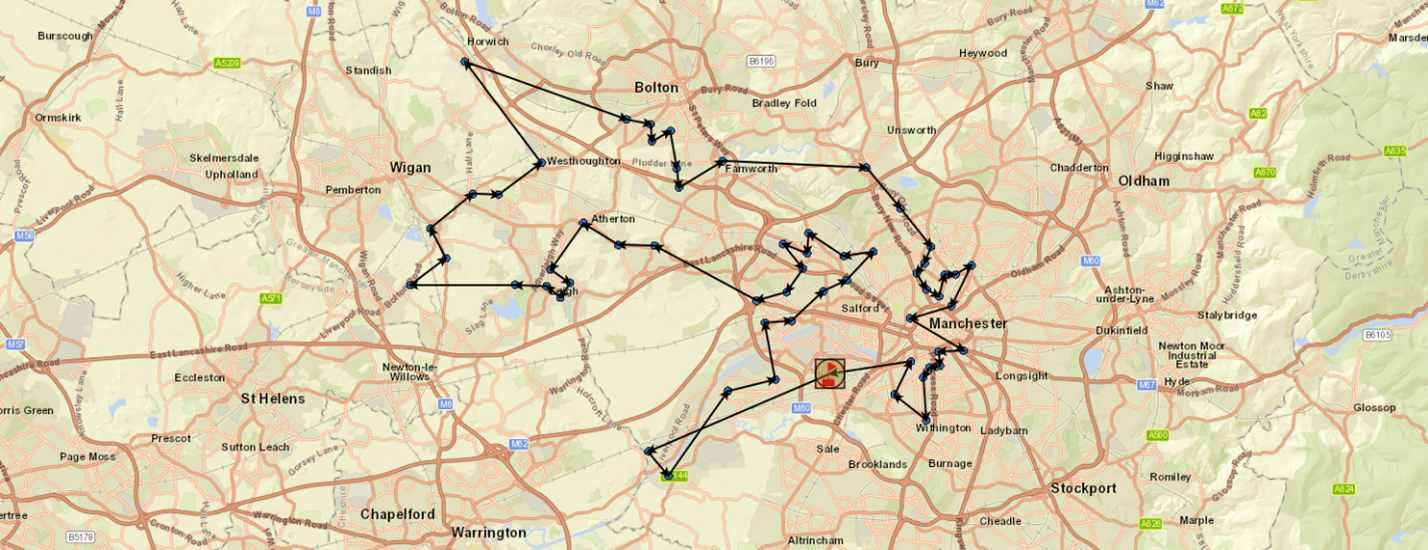
Academic research into the “vehicle routing problem” (VRP) began to influence thinking in the 1960s and 1970s, highlighting the potential for mathematical optimisation, although practical application in waste services remained limited. The foundational work of George Dantzig and John Ramser in 1959 formally introduced the truck dispatching problem, which became the basis of VRP. Building on this, Clarke and Wright developed the well-known Clarke–Wright “savings” algorithm in 1964, providing one of the first practical heuristics for reducing route length and fleet requirements.
Throughout the 1970s and 1980s, further academic contributions expanded VRP into more realistic variants. Researchers such as Paolo Toth and Daniele Vigo explored capacitated VRP formulations, while others examined constraints such as time windows, route balancing, and multi-depot scenarios. These developments were particularly relevant to waste collection, where vehicle capacity, disposal trips, and service frequency introduce significant complexity. In parallel, studies in urban logistics began to recognise waste collection as a distinct application area, with early modelling efforts demonstrating that even modest optimisation could yield meaningful reductions in distance travelled and operational cost.
Despite these advances, real-world deployment in municipal waste services lagged behind theory. Computational limitations restricted the size of problems that could be solved, and the highly localised, variable nature of waste collection – such as one-way streets, cul-de-sacs, and differing collection policies – made standard models difficult to apply directly. Academic studies often relied on simplified datasets or small case examples, limiting their immediate operational relevance.
It was not until the late 1980s and 1990s, with improvements in computing power and the emergence of GIS, that these academic principles began to transition into practical tools. Nonetheless, the early body of VRP research was critical in establishing the mathematical foundations that underpin modern route optimisation systems used in municipal waste and recycling today.
The 1990s and early 2000s marked a turning point with the rise of GIS-based tools. Municipalities in the UK, USA, and parts of Europe began digitising their street networks and service data.
Early software solutions enabled planners to visualise routes and apply optimisation algorithms, reducing travel distance and improving service consistency. During this period, solutions such as those now associated with platforms like RouteSmart emerged, combining GIS with sophisticated routing algorithms to model the unique constraints of waste collection.

In the UK, the advancement of route optimisation software deployment was boosted by the ongoing map service agreements that allowed local authorities to use Ordnance Survey mapping data for free. This enabled waste management consultancy companies, like Integrated Skills Ltd, to adopt route optimisation software and introduce it into the UK, Europe and Middle East markets. Solutions deployed across these regions routinely optimise collections at the individual property level, balancing efficiency, safety, and environmental impact.
By the 2010s, deployment expanded significantly across North America and Europe, with increasing adoption in the Middle East. Municipalities began integrating optimisation software into broader fleet and asset management systems. Case studies from cities showed measurable benefits, including reductions in route mileage, fleet size, and emissions. For example, optimisation initiatives have demonstrated distance savings of over 25% in some implementations.
At the same time, cloud computing and mobile technologies transformed how these systems were used. Instead of static, pre-planned routes, modern platforms allow dynamic route adjustments based on real-world conditions such as traffic, missed collections, or vehicle breakdowns. This shift reflects the reality that waste operations are highly variable and require continuous monitoring and adjustment. In-cab devices and GPS tracking now provide real-time visibility, improving accountability and service reliability.
Today, route optimisation is considered a core component of municipal waste strategy. In the UK, the technology has enabled local authorities to quickly adapt to new policies such as Simpler Recycling and Local Government Reorganisation that has led to the wholesale redesigning of collection rounds and service changes due to the food waste collection rollout.
Route optimisation systems, like RouteSmart Optimize, integrate with Waste Management Systems, such as SmartSuite from ISL, providing a unified platform for the waste & recycling collection & street service operations that incorporates digital mapping, job, task & round management, integration with telematics, finance systems and client facing web pages & apps, and even predictive analytics to support “smart city” initiatives.
Overall, the history of route optimisation in waste management reflects a broader digital transformation – from manual planning to intelligent, data-driven systems that are essential for modern urban & rural service delivery.